
Interview – Shiliang Tang
April 1, 2026

"If you control the distribution or you control the yield, then you have a business"
Onchain asset management is entering a new phase. As basis trades compress and DeFi yields normalise, a growing class of institutional managers are looking beyond single-strategy plays – blending CeFi, DeFi, and increasingly real-world assets into composite yield products. The question is no longer whether institutional capital will flow into onchain vaults, but who will manage it, and on what infrastructure.
Monarq is one of the firms answering that question. A multi-strategy digital asset manager overseeing more than $700 million – and majority-owned by FalconX – Monarq is now launching exclusive BTC and ETH yield strategies on Railnet, becoming one of the first institutional asset managers to go live on the platform.
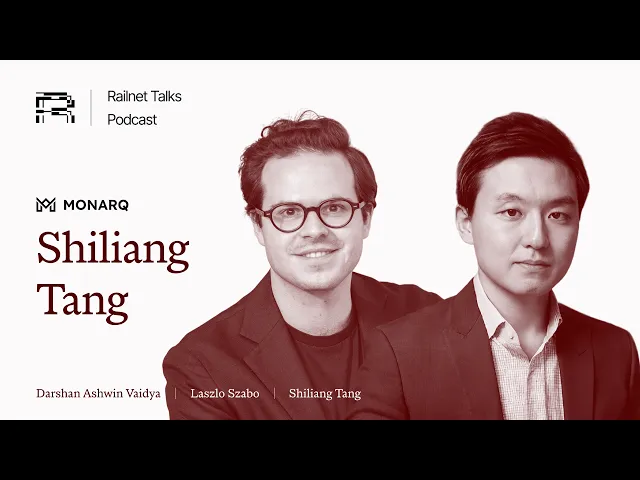
In the inaugural episode of Railnet Talks, Kiln CEO Laszlo Szabo and Head of Asset Management, Darshan Vaidya sit down with Monarq's Managing Partner Shiliang Tang to talk about his path from Wall Street quant desks to crypto, why Bitcoin is the most underserved institutional asset in yield terms, and what the onchain asset management stack still needs to get right. Below are the highlights – for the full conversation, watch the episode on YouTube.
From MIT to market making to crypto
Shiliang's background is unusual for a crypto fund manager. He studied chemical engineering at MIT, interned at Lehman Brothers and Merrill Lynch's subprime desk during the financial crisis, and spent years on high-frequency and options desks in traditional markets before crypto caught his eye.
You've built and exited multiple firms in crypto – Ledger Prime, Arbelos, now Monarq. How did the crypto journey start?
Shiliang Tang: Crypto first caught my eye on the trading floor around 2010–2012 – you'd see an asset go up thousands of percent and people start talking. I read the white paper, had friends who were early miners at MIT, bought some Bitcoin early. Mt. Gox knocked the wind out of my interest for a while. But in 2017 I looked again, saw how much infrastructure had been built – perps, options, real volume – and realised many traditional market strategies could be ported over. That's when I teamed up with the LedgerX folks and launched Ledger Prime. We built up a couple years of track record and in 2019 opened it to external capital.
Why multi-strategy matters
Monarq runs three funds – a dollar-denominated quant fund, a Bitcoin-denominated yield fund, and a directional long/short fund – all built on the same principle: no single strategy works in every environment.
How does the multi-strategy approach play out in practice?
Shiliang Tang: Alpha comes and goes. Look at Q1 2024 – Ethena, Pendle, and the point-farming wave made DeFi strategies very attractive. Then that dried up. The Trump election spiked vol and trend-following did extremely well. Now basis is flat and people are searching for yield elsewhere. We overlay market making, arbitrage, vol trading, stat arb, and DeFi – and over time, that smooths returns and dampens volatility. We're always reinventing ourselves because crypto just moves so quickly.
The team reflects this blend. Monarq draws from Ledger Prime, Tower Research, BlockTower, and Citadel – a mix of TradFi quant and crypto-native talent. Shiliang is candid that in the early days, the TradFi-heavy composition was actually a disadvantage: the team was slower to grasp DeFi's idiosyncratic products and market microstructure. But as crypto and traditional markets converge – RWAs onchain, crypto-related equities, tokenised everything – that traditional expertise has become an edge.
"The lines between traditional markets and crypto are truly blurring. Having deep experience on both sides is becoming a real advantage."
The Bitcoin yield gap
Monarq's first vault on Railnet is denominated in Bitcoin – a deliberate choice tied to a simple structural observation.
Why Bitcoin as the first onchain vault?
Shiliang Tang: Bitcoin is still the premier institutional asset in crypto, but it has no natural yield. With cash, you can deposit it and earn SOFR. With Bitcoin, you can't. There are billions sitting onchain earning nothing – or maybe 1%. Most holders aren't looking for 15 or 20%; they'd be happy just matching the risk-free rate. If we can deliver up to 6% in an institutional-grade product, there's a massive pool of capital for that.
What's changed is Bitcoin's acceptance as collateral. Exchanges, OTC desks, and DeFi protocols now treat it nearly on par with stablecoins for margining. That opens the strategy set wide – from options and stat arb on centralised venues, to borrowing stablecoins against BTC onchain through Aave or Morpho, then deploying those stables into higher-yielding DeFi strategies. The spread after borrow costs is the target yield.
An ETH strategy will follow shortly. The dynamics differ: ETH carries a native staking yield (~2–3%), which raises the hurdle rate but also gives the strategy a higher starting base. Monarq is targeting mid-to-high single-digit yields for ETH, positioned as a complement to plain staking – investors keep the bulk of their assets in safe staking and allocate 5–20% into a strategy like Monarq's for incremental yield.
Why Railnet
When asked what drove the decision to launch on Railnet specifically, Shiliang frames it as a distribution-plus-infrastructure bet.
Shiliang Tang: In onchain asset management, the winners will be those who control either the distribution or the yield. Everything in between is hyper-competitive with low barriers to entry. Kiln already has that distribution through its existing staking product suite – that was important for us, because vault depositors are a very different audience from traditional LP fund investors.
On the technology side, ERC-4626 was fine for liquid DeFi strategies. But we're heading toward a world where vaults need to handle real-world assets – private credit, commodities, things with off-chain settlement. ERC-7540 and what Railnet is building handle that friction natively. That's a natural fit for the multi-strategy approach we run at the fund level.
Shiliang also highlights a broader problem that Railnet is positioned to solve: the fragmentation of running a crypto fund today. Managing across centralised exchanges, crypto prime brokers, OTC desks, DeFi protocols, and traditional PBs – none of which are connected – makes real-time reporting and risk transparency extremely difficult. The promise of onchain asset management, in his view, isn't just non-custody and transparency; it's bringing all of these fragmented pieces into a single, more automated infrastructure layer.
Looking ahead
Asked for bold predictions, Shiliang focuses on infrastructure rather than price.
Shiliang Tang: The speed at which traditional financial infrastructure moves onchain will surprise people. Tokenised money market funds, stablecoin rails, onchain settlement – it looks unremarkable on the surface, but these are the building blocks of repo markets, interbank lending, and capital markets plumbing. Within a year or two, a very large chunk of that infrastructure will be running on blockchain rails. It might not feel different on the front end, but behind the scenes, the shift will be dramatic.
He's also watching prediction markets (the natural crypto UX for the zero-DTE options trend), real-world assets on perp rails (particularly if the CFTC opens the door), and programmable AMMs – a new generation of onchain market-making that's beginning to produce tighter liquidity than some DEXs for certain assets.
*This is the first episode of Railnet Talks, a podcast series spotlighting the asset managers, builders, and partners shaping onchain finance through the Railnet ecosystem.
Download our 1-pager
Watch the full conversation with Shiliang Tang on YouTube →